Read on to learn about:
- Types of AC units
- AC cooling capacity and how it is measured
- Ensuring you have the right cooling capacity for the size of your home
- The energy efficiency rating for air conditioners
- AC noise levels
- AC maintenance requirements
Types of Air Conditioning Units
There are a variety of types of air conditioners used in homes. This article focuses on one type of AC unit, a split air conditioner.
To truly understand the difference between the types of residential air conditioners, I will explain each type and where they are best used.
Split Air Conditioning
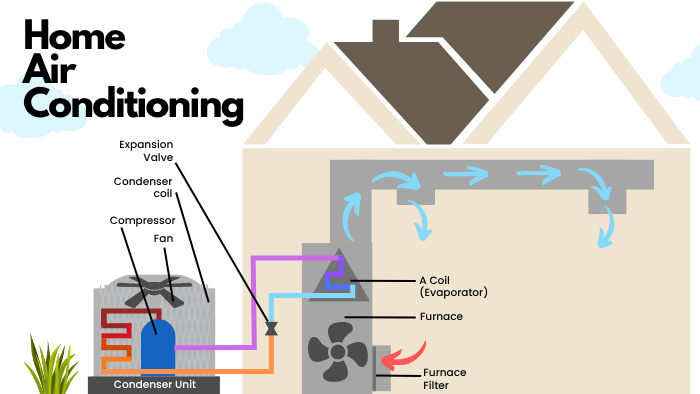
Split air conditioners have 2 major components split between them: an indoor component and an outdoor component.
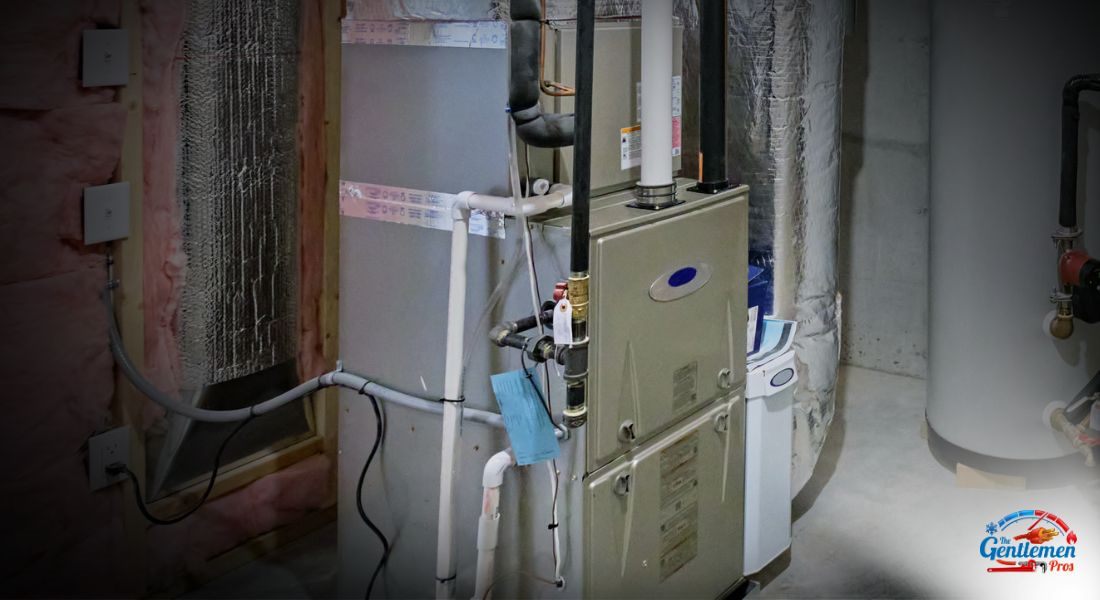
The indoor unit contains the cooling coil (or A-coil). The outdoor unit houses the compressor and condenser. The A-coil sits on top of the furnace and cools the air. The furnace blower and ductwork are used with the air conditioner.
To understand how this works, read How Does A/C Work?
Ductless Mini Split Air Conditioner
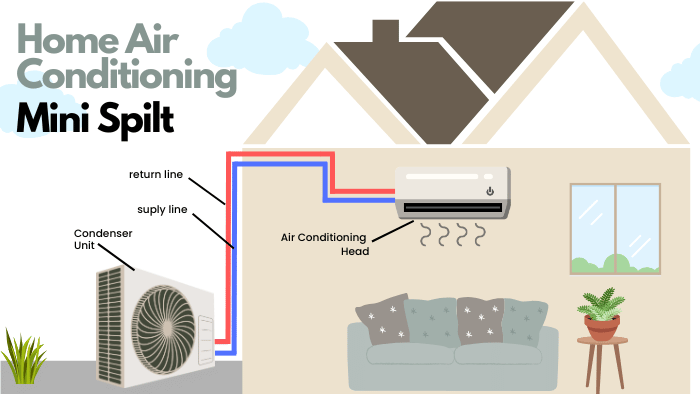
A ductless mini split air conditioner operates on the same principles as a split AC system, except that it does not require venting for distribution.
Just like a typical AC split system, there is an outdoor unit that houses the compressor and condenser.
Individual indoor AC units are placed in specific areas, providing cooling for the room. The indoor units can be controlled individually, allowing different temperatures in each zone.
A mini-split is not as aesthetically appealing and isn't ideal for a large home.
Central Air Conditioning
Central air conditioning systems are synonymous with ductwork that allows cool air to flow through your entire home.
Central air conditioning operates on a split AC system, but not a ductless mini-split system.
In Calgary, Edmonton and Red Deer, most of us use a furnace for central heating. (One exception is a boiler system.) Consequently, when AC is installed in a home in Calgary, Edmonton or Red Deer, the existing ductwork will be used to convey the cool air through the home.
A mini-split AC system, on the other hand, doesn't require ductwork and can be controlled locally where the indoor units are placed.
Window Air Conditioning
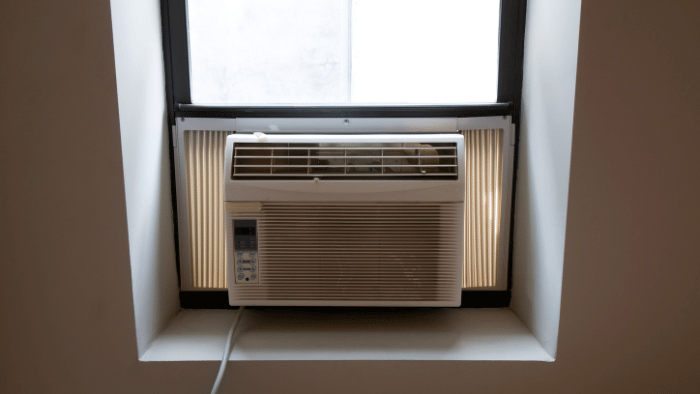
An affordable option, window AC units can cool a room or small space.
Window AC units are self-contained, meaning all the parts work together in one unit. Window ACs have limitations, but they are easily installed and a relatively inexpensive option.
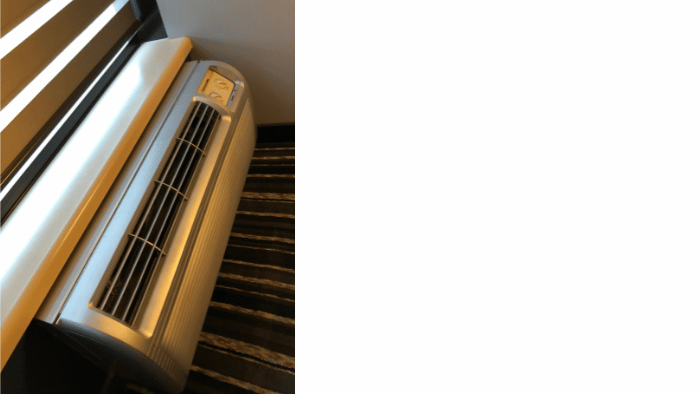
Packaged Terminal Air Conditioners (PTAC)
Think of a hotel room when you are picturing a packaged terminal air conditioner.
They are self-contained units that are installed through a wall or window and often provide both heating and cooling functions.
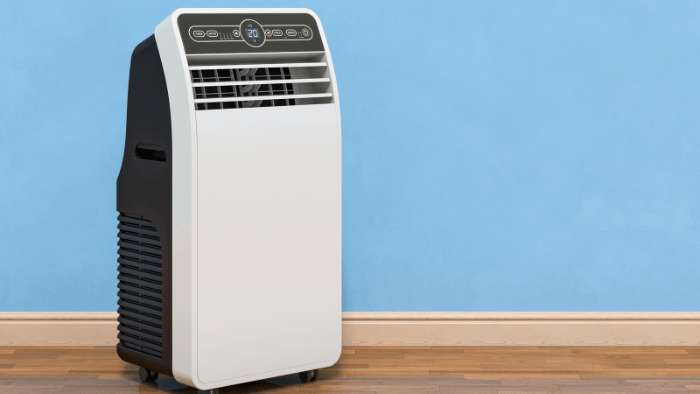
Portable Air Conditioners
Portable air conditioners are stand-alone units that can be moved from one room to another.
They usually vent through the window with a temporary vent kit that can be moved from one window to another.
Portable air conditioners are usually very affordable and have the ability to cool a room.
AC Type Comparison
| Type |
Best For |
Pros |
Cons |
| Central Air |
Whole home cooling |
Even cooling, hidden equipment |
Requires ductwork |
| Ductless Mini Split |
Rooms or additions |
Zoned control, efficient |
Indoor wall units visible |
| Window AC |
Single rooms |
Affordable, simple install |
Noisy, limited cooling |
| Portable AC |
Temporary cooling |
Movable, no install needed |
Less efficient, takes up floor space |
| PTAC |
Hotels & suites |
Heating & cooling in one |
Not ideal for homes |
Why Is Air Conditioning Cooling Capacity Measured in Tons?
Good question!
Just like horsepower, a measuring unit transitioning from horse to steam power, a ton of refrigeration (or refrigeration ton) was a unit of measure predating mechanical refrigeration.
In the 1800s, ice harvesting became a thriving industry. Ice was transported and used to cool icehouses and iceboxes, providing refrigeration.
Read about the history of the ice trade
A refrigeration ton is the amount of heat transferred to melt one ton of ice in 24 hours.
Obviously, the historical reference to ice is relevant to modern air conditioning systems, but the term "ton" stuck around and is still a measurement of cooling capacity.
Today, when choosing cooling capacity, it is important to understand the various factors involved to ensure you have the right cooling capacity. Room size, climate conditions, and insulation are important factors that are considered before your AC installation.
What Is a BTU?
BTU stands for British Thermal Unit and is a unit of measurement commonly used in the heating, ventilation and air conditioning industry.
One ton of refrigeration, or cooling capacity, is equivalent to 12,000 BTUs per hour.
In the heating and cooling industry, BTUs are used to measure heating and cooling capacities. The cooling capacity of an air conditioner is often measured in terms of BTU/h.
It is extremely important to ensure that the BTU rating meets the requirements of your home!
Learn more about refrigeration tons on Wikipedia
Size Matters: Choosing the Right AC Unit for the Size of Your Home
Be sure to choose the right AC unit, with the correct cooling capacity for the size of your home.
Many factors influence the amount of cooling capacity needed to cool your home. The size of your home is the greatest factor, but other variables influence it.
- Size of your home
- Insulation levels
- Climate
- Ceiling height
- Window orientation and size
We strongly recommend having an HVAC specialist do a detailed load calculation to determine the needed AC cooling capacity.
A Manual J calculation was developed by the Air Conditioning Contractors of America and is a widely accepted industry standard. It takes into account square footage, insulation levels, climate conditions, window orientation, ceiling height, and occupancy.
The rule of thumb, in estimating the cooling capacity required for an area, is 1 ton of cooling capacity for every 400–600 square feet. Don't base your AC purchase on a rough estimate — we advise talking with an HVAC technician who can provide a detailed load calculation.
How Do I Avoid Hot Spots or Cool Spots in My Home?
A detailed load calculation takes into account all the factors affecting cooling capacity needs. Carefully determining the cooling load needed can prevent having hot spots or cool spots in your home.
Simple rule-of-thumb methods can be misleading and result in the wrong AC model being installed. We know from experience that a detailed load calculation is often overlooked.
Airflow is another important consideration in maintaining a consistent temperature in your home. Adequate supply and return vents that are strategically placed help circulate the air. Ceiling fans can also promote air circulation and regulate temperature imbalances.
Airflow obstructions can inhibit good airflow circulation and create temperature imbalances. Be sure to move anything blocking the vents — adjust rugs, curtains or furniture that disrupt the airflow.
Regular maintenance and cleaning of your air conditioner can help maintain airflow. The coils and fins inside the AC compressor can be damaged very easily — be sure to consult a professional on the best way to clean and maintain your air conditioner.
Zoning systems can help create optimal comfort by dividing the home into various zones with independent temperature controls.
SEER: Energy Efficiency Rating for Air Conditioning
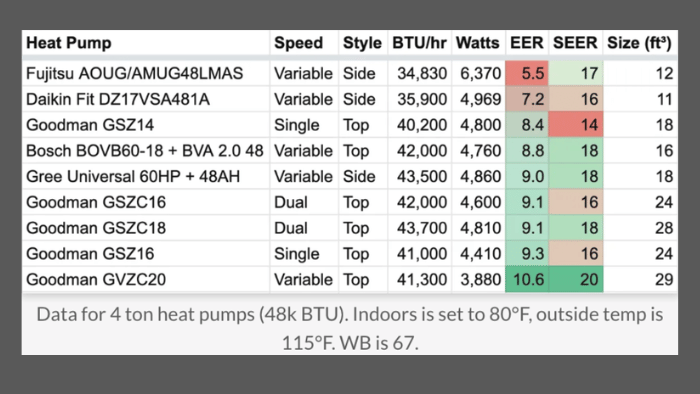
A SEER rating is often used as a measure of efficiency for air conditioning systems. SEER stands for Seasonal Energy Efficiency Ratio.
The higher the SEER rating, the more energy-efficient the air conditioner is.
A SEER rating is calculated by dividing the cooling output in BTUs by the energy input in watt-hours over the cooling season:
SEER = Total Cooling Output (BTUs) ÷ Total Energy Input (watt-hours)
For example, if your air conditioner had a SEER rating of 14, it would mean that for every 1 watt-hour of energy input, the air conditioner provides about 14 BTUs of cooling output during the cooling season.
Keep in mind that the SEER rating rates the AC unit at its peak operating efficiency — just like fuel efficiency in a car, the ratio changes depending on the conditions.
What SEER Rating Do I Need?
In some areas, a minimum SEER rating is required by law:
| Region |
Minimum SEER |
| Most U.S. states |
14 SEER |
| California |
15 SEER |
| Most Canadian provinces |
13 SEER |
| British Columbia |
14 SEER |
| Alberta |
No minimum requirement |
Is High-Efficiency AC Worth It?
Having an energy-efficient AC unit may save you money on your energy bill. Consider the pros and cons of various AC units, including efficiency, cost, and the amount of cooling required in your home.
The amount of cooling required varies for many reasons, including:
- The size of your home
- How often your AC is used
- The temperature you like to keep your home at
- The number of days per year when air conditioning is needed
- The structure and building materials used in your home
SEER Rating Isn't Everything
Choosing an AC unit with the highest SEER rating isn't always worth the cost or trade-offs.
Most air conditioning units have a SEER rating between 13 and 22. In Calgary, Edmonton, or Red Deer, where air conditioning is only needed a few months of the year, the energy savings from an AC unit rated above 20 most likely would never be fully realized.
Higher-SEER-rated AC units can be more costly upfront, have more expensive replacement parts, and can cost more to service.
| SEER Rating |
Efficiency Level |
Upfront Cost |
Best For |
| 13–14 SEER |
Standard |
Lower |
Most Alberta homes |
| 15–17 SEER |
Mid efficiency |
Moderate |
Balanced efficiency & comfort |
| 18–22+ SEER |
High efficiency |
Higher |
Hot climates or heavy AC use |
Here are a few tips to consider when evaluating efficiency:
- In Alberta, operational cost savings may not outweigh the higher purchase price of a top-tier unit given the short cooling season.
- A SEER rating only represents the maximum efficiency of an air conditioner — it does not reflect how the unit performs under every circumstance.
- Be wary of online SEER savings calculators. Operational costs and savings differ significantly depending on your climate.
- An EER (Energy Efficiency Ratio) can be a more accurate indicator of real-world operating costs in cooler regions like Calgary.
Read more about misleading SEER ratings
Single-Stage vs. Two-Stage vs. Variable-Speed Air Conditioners
Just like a furnace, air conditioners are available in single-stage, dual (two-stage), or variable-speed configurations. The difference is how precisely the unit can match its output to your actual cooling demand.
| Type |
Comfort |
Efficiency |
Noise |
Cost |
| Single-Stage |
Basic |
Lower |
Louder |
$ |
| Two-Stage |
Better |
Moderate |
Quieter at low stage |
$$ |
| Multi-Stage / Variable |
Best |
Highest |
Quietest |
$$$ |
Single-Stage Air Conditioners
In the simplest terms, single-stage air conditioning has an off and an on. Whenever it runs, it operates at full capacity — regardless of how much cooling is actually needed.
The biggest advantage of a single-stage air conditioner is the price. A single-stage unit will effectively cool your home, though you will spend a little more on your energy bill compared to more efficient alternatives.
In Calgary, Edmonton, and Red Deer, where cooling needs are less demanding than in warmer climates, a single-stage unit may be your best choice.
Two-Stage Air Conditioners
Dual-stage or two-stage air conditioners provide more efficiency. The compressor operates at two levels — typically around 65% in stage one and 100% in stage two — allowing the unit to provide less cooling when less is required, saving energy and cost.
A two-stage AC unit is a reasonable compromise between a single-stage and a multi-stage unit, offering improved efficiency at a moderate price increase.
Multi-Stage Air Conditioners
Multi-stage air conditioners operate on variable settings or speeds, matching their output to the exact cooling demand. This makes them more efficient and capable of more precise temperature control.
The major drawback is price. In Alberta's shorter cooling season, the operational cost savings are less likely to justify the higher upfront cost. Consult with a heating and cooling specialist to understand your specific cooling needs before committing.
Modulating / Variable-Speed
Modulating or variable-speed AC units offer the most precise and efficient cooling available. The compressor and fan speeds adjust continuously to match the exact cooling demand at any moment.
These systems are typically the most expensive. While generally more energy-efficient than multi-stage units, the added cost may not be justified in cooler climates with shorter cooling seasons.
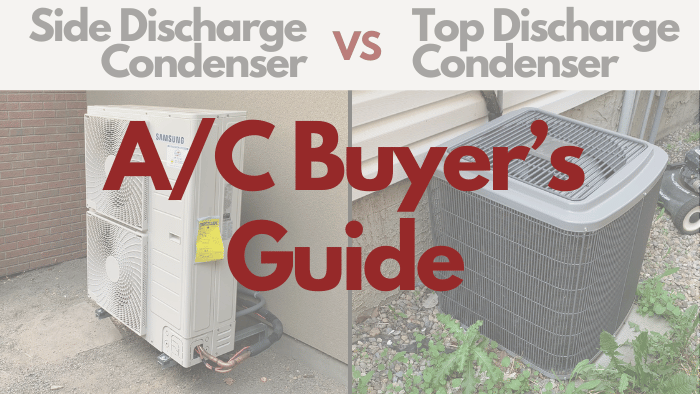
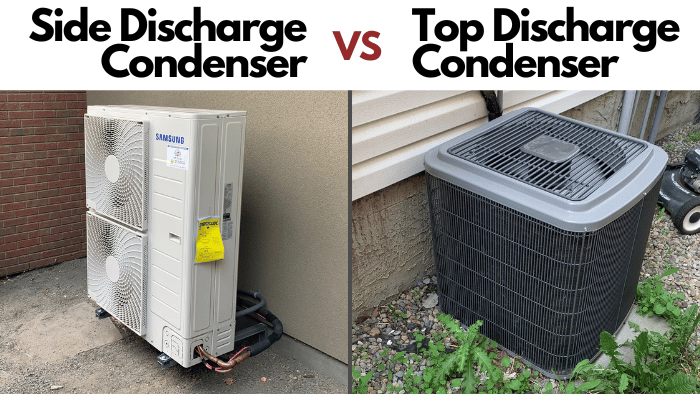
Side Discharge vs. Top Discharge Condensers
In a split air conditioning system, the outdoor condensing unit can be either a top discharge or a side discharge configuration.
Top discharge units are very common and typically larger. In suburban areas where yard space is plentiful, top discharge units are most common. Side discharge units are narrower and designed for urban centres where space is limited.
Many side discharge units use inverter technology, making the compressor quieter and more efficient. However, a larger top discharge unit has more coil surface area, which lowers compressor pressure and reduces energy use.
Apples to apples, a larger top discharge condensing unit with inverter technology would most likely provide the best energy efficiency.
Are Some AC Units Noisier Than Others?
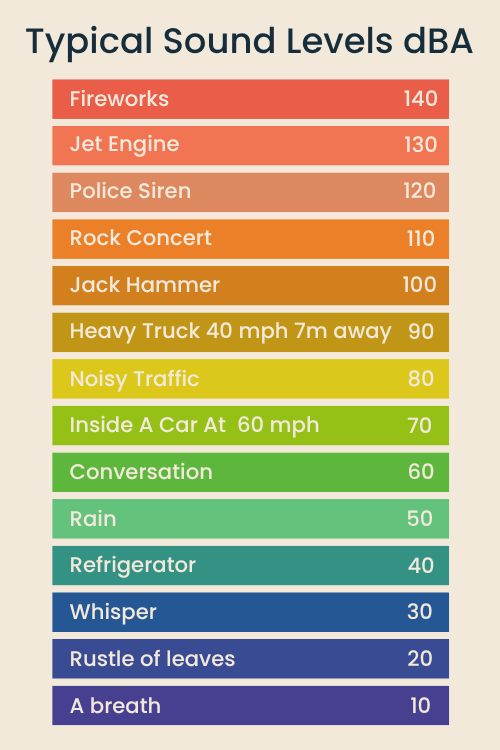
Yes, some air conditioners are significantly louder than others.
Noise levels are measured in dBA — decibels adjusted for amplitude. This accounts for how the human ear perceives sound, giving less weight to low and high frequencies that humans hear less clearly. Lower dBA ratings indicate quieter operation.
AC units are typically rated for noise at 3.3 feet from the condenser, and often again at 6.6 and 9.8 feet.
| dBA Rating |
Noise Level |
Comparable To |
| 50–55 dBA |
Very quiet |
Quiet conversation |
| 56–65 dBA |
Moderate |
Dishwasher |
| 66–75 dBA |
Louder |
Vacuum cleaner |
A few factors that influence noise levels:
- Single-stage units always run at full capacity, producing maximum noise every cycle.
- Two-stage and multi-stage units are noticeably quieter when operating at lower stages or speeds.
- Rotary compressors are significantly quieter than standard compressors and among the most efficient available.
- The placement of the outdoor condenser matters — position it away from decks or outdoor gathering areas where possible.
AC Maintenance Requirements
Did you know you should have your AC unit serviced every year?
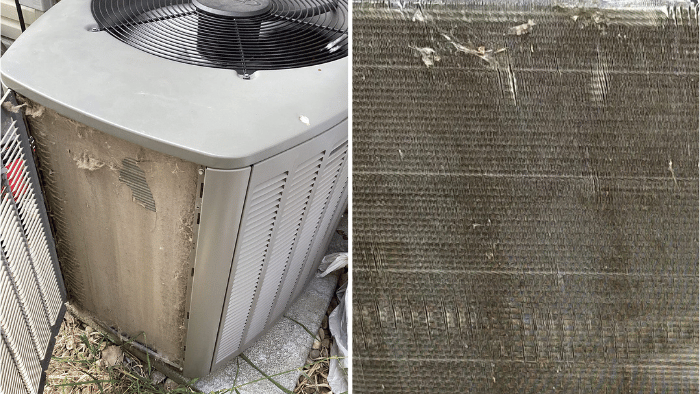
Proper maintenance on your AC unit will ensure that your AC operates at peak performance. Dirt, dust, leaves, and debris can get into the outdoor condensing unit and disrupt airflow efficiency. The coils and fins bend and damage very easily — always have a professional inspect and clean the unit rather than attempting it yourself.
Annual maintenance and inspection will detect problems early. A technician can identify:
- Refrigerant leaks
- Faulty or worn components
- Signs of corrosion or wear
- Airflow problems
Some manufacturers also require yearly maintenance to maintain warranty coverage.
Read more about servicing and maintaining your AC: How Does an AC Work?